
Oops! I almost missed the mid-week post because I forgot today is Wednesday. Don’t ask why!
This week, I’m going to look at something that may be blindingly obvious to many of you, but which I realised less than a month ago…
Positions
Until recently, I treated every spot trade as separate and individual. I’m obsessive like that.
For example, I bought 0.00896303 BTC a few weeks ago at $112,800 (blimey, that price dropped fast, didn’t it?).
I then bought 0.00532149 BTC at $108,111.
Normally, I would consider those two separate items and plan sales accordingly: a 1% gain on each, for example, at $114,041 and $109,300 respectively.
But then I noticed the “Positions” tab on MEXC’s trading screen (down there in the orders bit). And I combined that with how margin trading works for the clever person I’m following. And a little light bulb went on over my head.
Ding!
When a margin trader opens (for example) a long trade and the price goes down, they can either wait for it to come back up or they can add another piece to their trade – their “position” – at the lower price. That reduces the average cost of the whole chunk of crypto and means the price doesn’t need to rise as much to profit.
So those two BTC trades I mentioned can be seen together as one position of 0.01428452 BTC at around $111,053. My 1% trade on the whole lot sits at $112,275 – lower than the first buy, higher than the second, hopefully easier to hit. Yes, I know it didn’t work out like that!
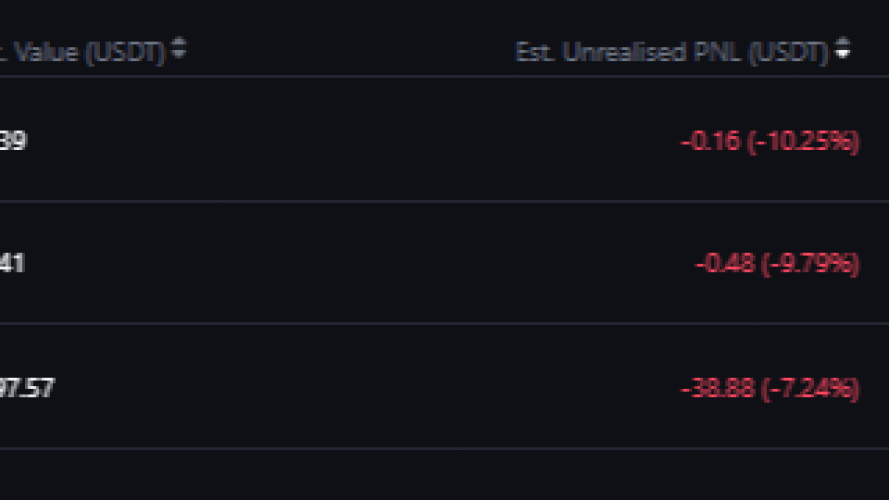
Considering everything in positions also means I have less bookkeeping to worry about. MEXC tracks each position and shows its current value, with PNL, like this example from my account:

Unfortunately, it’s not very accurate. It keeps track of everything in each coin for a certain period and the average buy price is regularly skewed, especially if you buy and sell frequently. It doesn’t seem to zero out when you sell everything, for starters.
Thankfully, it has an “edit” option on the average buy price, so you can manually update it to track things properly.
Excel
So how can you keep those figures accurate?
Let’s use the two bits of BTC from earlier.
Firstly, you need to know how much you bought and at what price. You can get that from your trade history, of course, though I tend to write it down when I set the buy – it’s easier and I don’t have to trawl through lots of trades! Multiply those two numbers together to get the value of the trade.
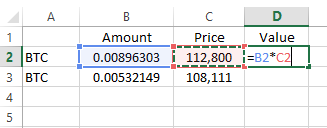
Now we’ll add a “Position” line. In the amount, add the two amounts of BTC (=B2+B3). Do the same for value (=D2+D3).
To find the price of the position – the average amount it cost for the combination of those two purchases – the formula is (=D5/B5).
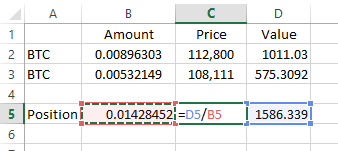
As always in Excel, a good way to do things is to point and click. The position price is the cost (click on the total value) divided by how much you got (click on the total amount). Job done.
You should get a price of 111,053.01 (roughly).
This calculation works for any number of purchases. Just keep adding them up into the position totals and the position price will work itself out.
Update MEXC
Once you’ve got your position price, you can put that into the MEXC table. Click the edit button next to the average price, delete what’s there and type in your accurate version. Note that you might have to reduce the number of decimals before it lets you confirm… and now their system will tell you when you’re in profit or running a loss, constantly updated on your trading page!
I’m not going to pretend it’s been an easy shift for me, letting go of the individual trade obsession, but the payback is worth it so far.
Do you use individual trades or positions? Any special strategies?