
Welcome to the mid-week info post!
I’m still thinking about trading, so I’m going to look at TP and SL today. I’m talking specifically about spot trading, whether it’s day trading, swing trading or some other form of spots.
- TP = Take Profit
- SL = Stop Loss
Pretty much every exchange offers these features, only one of which I use.
Take Profit
I use TP to manage my lack of patience, my aversion to risk and my constant self-doubt when trading.
At its simplest, TP is a wonderful tool for people like me, who constantly struggle with the fear of “missing out” on higher profits from a pump, but who never know when a coin’s price has peaked. Far too often, I used to sit here thinking “Is that going to go higher? Should I sell now? How stupid will I feel if I sell now and it goes up another 5%?!”
Instead of worrying about price pumps and missing out, I use TP to decide how much I want to gain from a spot trade (combined with what’s likely to work) and set the selling price before I even buy, fixing the thing in place and removing the constant reassessment. Well, at least until the price dithers around and I start re-thinking the profit margin, then have to convince myself to stick with what I’d decided!
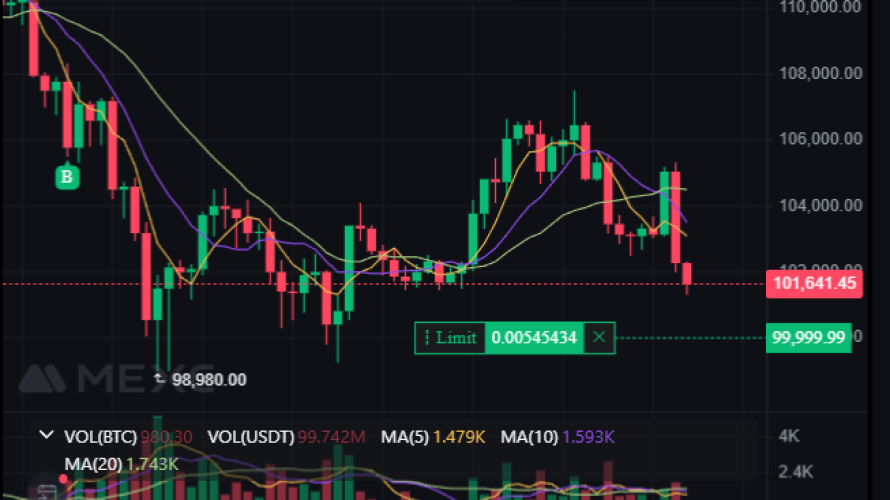
A great example of TP is my GRT trades. Recently, I bought in a small dip at 0.0605 USDT, marked TP and set the sell price at 0.06353 USDT (a 5% gain, which MEXC shows as a tooltip when entering the TP price). Put in the order and walked away. Once the price dipped to 0.0605, the buy went and the system immediately set up a TP sell at 0.06353. I didn’t need to worry about it any more, or monitor it in any way.
A while later, when GRT pumped up to 0.075 or something. It went straight through my sell price and the TP triggered.
I followed that buy with another in the dip, so ended up with about 6% profit on the whole lot when it pumped, as I mentioned on Sunday.
OK, so there’s a little part of me that thinks I could’ve made more profit if I hadn’t used TP (like 20% or more), but how would I know it had peaked unless I constantly monitored the price? Who’s to say I’d be around if it was a quick pump that fell back to where it was almost immediately? That 6% is a lot for a single, short-term trade and I’m happy with it.
TP also works when you’re selling: you can set your limit price, mark TP and put in the lower price at which you want to buy. The system will set up a buy order for the same value of crypto when yours sells – note that it’s the sold crypto’s value it uses, so if you sell $15 of BTC, the TP buy will be for $15 of BTC at the lower price, leaving the profit in your spot account. Took me a while to get used to that idea and, to be honest, I don’t use it in that direction.
I also try not to adjust the TP buy/sell before it triggers unless the market moves massively. Doing that risks getting myself into the worrying mindset where I rethink everything and make a horrible mess!
Stop Loss
I don’t use Stop Loss.
I probably should, but my first thought is always about volatility.
If I set a Stop Loss at, say, 5% below my buy price, it’ll stop me losing more. But we’re talking about markets where 5% is a fairly common movement, so it could drop 5.1%, then pump straight back up to 5% in the other direction… and I’d lose out because my SL would trigger and sell at 5% down.
It’s risky, I know, but I just don’t see the point unless you’re trading in extremely volatile markets with huge movements.
Excel
I’m a bit obsessive about numbers and tracking, so I have an “Earn £1 Million Through Crypto” spreadsheet.
As I go through ideas and thoughts, I’ll post bits here in case they’re useful to anyone else. I’m reasonably good at basic maths and a bit of a whizz with Excel, but I’ll keep it all very simple and assume you hate both maths and Excel (or Google Sheets, where these things all work as well).
My little space to do the percentage calculations for TP quickly is simple enough: buy price in a cell, then several to the right with fixed percentage gains, like this:
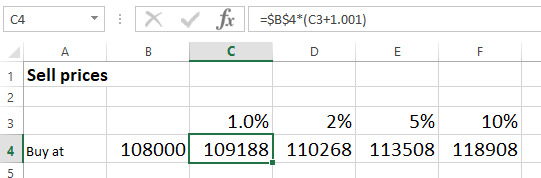
So if I buy BTC at $108k, 1% profit will be a TP of $109,188. That’s a pretty simple formula: (buy price x 101.1%), which includes 0.1% fees. I’m never sure if a TP sell counts as Maker or Taker, so I add the fees in case. Maybe I earn an extra 0.1% each time. 🙂
2% is the next cell (buy price x 102.1%) and so on. I actually do (buy price x (percentage + 100.1%)) so I can change the percentages and the numbers adjust.
You can see the formula there for the 1% calculation, using an absolute address (the $ signs) for the buy price, so you can just copy/paste that formula across the other percentage columns.
Next week, I’m going to look at something I learned (or realised) recently: Positions.
Do you use TP and SL in your trades? Would love to know if you have specific strategies!